Yoga Nidra vs. Meditation — What's the Difference and Which One Is Right for You


Yoga Nidra vs. Meditation — What's the Difference and Which One Is Right for You
Both involve closing your eyes, sitting or lying quietly, and doing something with your attention. Both come from contemplative traditions. Both produce measurable effects on stress, focus, and emotional regulation.
But yoga nidra and meditation are not the same practice — and understanding the difference matters, especially if one of them hasn't been working for you.
The Core Difference
Most meditation practices are active. You maintain a degree of effort — returning attention to the breath when it wanders, holding a mantra, observing thoughts without following them. There's a meditator doing the meditating.
Yoga nidra is receptive. You lie down. A guide leads your attention. Your job is to follow without effort or judgment. The practice happens to you more than through you.
This distinction has real implications for who benefits most from each, and when.
What Meditation Is (And What It Asks of You)
Meditation encompasses many traditions and techniques — mindfulness, vipassana, transcendental, loving-kindness, open awareness, and dozens more. But most share a common structure:
- You sit (or stand, or walk) in an alert posture
- You direct attention to an anchor — breath, mantra, sensation, object
- When attention wanders (and it will), you notice and return
- This noticing and returning is the practice
Meditation trains meta-cognition — the capacity to observe your own mental activity. Over time, the gap between stimulus and response widens. You become less identified with your thoughts. This is valuable, and the research behind it is substantial.
But it requires a baseline capacity for sustained attention. For people in acute stress, chronic fatigue, or nervous system dysregulation, the effort of "returning attention" can feel impossible — or can even trigger frustration that deepens rather than reduces stress. These people don't fail at meditation because they're doing it wrong. They often fail because they're using the wrong tool.
What Yoga Nidra Is (And What It Asks of You)
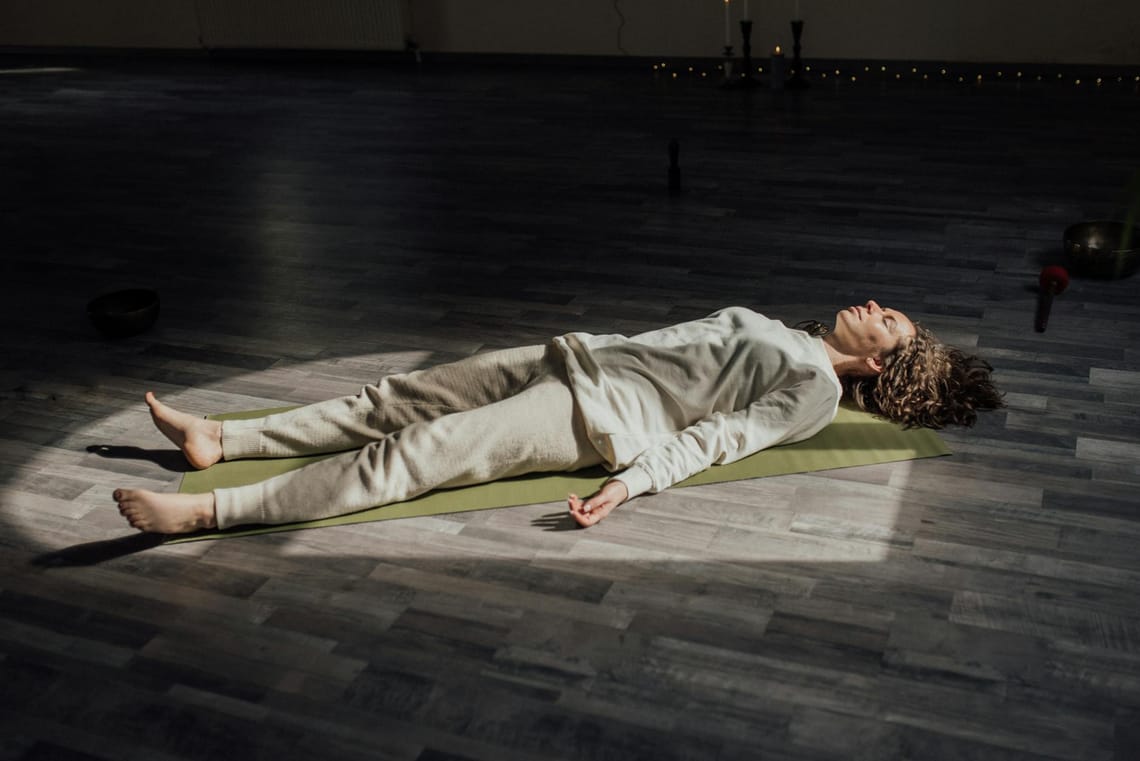
Yoga nidra asks almost nothing of you. You lie in savasana. You follow a voice. You notice what you notice — and when your attention wanders, that's fine too. There's no correct experience. There's no way to do it wrong.
Rather than training attention to stay in one place, yoga nidra moves attention systematically through the body, the breath, sensation, emotion, and imagery. Each layer of the practice corresponds to one of the five koshas — the traditional yogic framework for the layers of the human being from physical to spiritual.
This systematic movement, combined with the shift into theta brain waves (the hypnagogic state just before sleep), creates conditions for deep rest and integration that are physiologically different from meditation.
Brain Waves: Where They Diverge
Brain wave states are one useful way to understand the difference (Datta et al., 2022):
| State | Brain Waves | Associated With |
|---|---|---|
| Active thinking | Beta (13–30 Hz) | Analytical thought, stress, focus |
| Relaxed alertness | Alpha (8–12 Hz) | Calm awareness, light meditation |
| Meditation (most forms) | Alpha–Theta | Mindfulness, focus, observer state |
| Yoga nidra | Theta (4–7 Hz) | Hypnagogic state, emotional processing, deep integration |
| Sleep | Delta (0.5–3 Hz) | Physical repair, unconscious rest |
Yoga nidra reliably induces theta states — the same brain wave territory you pass through as you fall asleep, and the state associated with memory consolidation, creative insight, and emotional integration. Most active meditation forms operate in alpha or alpha-theta ranges, which is valuable for different reasons.
What Each Practice Does Best
Meditation is better for:
- Training sustained attention and focus
- Developing meta-cognitive awareness (observing your thoughts)
- Long-term structural changes in attention regulation
- Active engagement with thought patterns
- People who have a baseline capacity for sitting quietly with effort
Yoga nidra is better for:
- Deep nervous system rest, especially for those in burnout or chronic stress
- Emotional processing and integration
- People who "can't meditate" or find active meditation frustrating
- Physical recovery and sleep support
- Accessing the subconscious (via sankalpa and theta state)
- People with high sensitivity who need complete effortlessness
Can You Do Both?
Yes — and many practitioners do. They're not competing practices. They work on different aspects of mind-body wellbeing and can complement each other well.
A common approach: meditation in the morning (when the mind is active and the practice of returning attention feels productive), yoga nidra in the afternoon or evening (when rest and integration are what the nervous system needs).
Some practitioners use yoga nidra as a foundation — developing the capacity for witness awareness and nervous system regulation — before moving into active meditation practices. The deep rest of yoga nidra can make active meditation feel more accessible over time.
The "I Can't Meditate" Problem
If you've tried meditation and felt like you failed — like your mind was too busy, you kept falling asleep, or you just couldn't "get it" — yoga nidra is almost always worth trying.
The common frustrations with meditation (restlessness, the feeling that you're doing it wrong, frustration at wandering attention) simply don't apply to yoga nidra. You can't do it wrong. Wandering attention doesn't matter. Falling asleep is not failure.
This isn't because yoga nidra is the "easy version" of meditation. It's because it's a different practice entirely — one that doesn't ask for effort as its mechanism.
If you'd like to understand yoga nidra more deeply before starting, our complete guide to what yoga nidra is and how it works covers the science, the stages, and what to expect in your first session.
Which One Should You Start With?
A few questions to help you decide:
Start with yoga nidra if:
- You're in a period of high stress, burnout, or exhaustion
- You've tried meditation and felt frustrated or like you failed
- You have sleep difficulties
- You're processing grief, anxiety, or emotional overwhelm
- You're a highly sensitive person who needs effortless rest
Start with meditation if:
- You want to develop focus and attention as a skill
- You're in a relatively stable baseline state
- You're drawn to active engagement with your thought patterns
- You want the long-term structural changes in the brain that active practice builds
There's no wrong choice. Both are valuable. And you can always try one, notice what it does for you, and add the other.
If You Want to Go Deeper into Yoga Nidra
Colynn Vosburgh's course Yoga Nidra for Emotional Intelligence combines traditional nidra practice with emotional intelligence training — helping you understand not just how to do the practice, but how to use it as a tool for specific emotional processing and regulation.
Explore Yoga Nidra for Emotional Intelligence →
Frequently Asked Questions
Is yoga nidra a form of meditation?
It depends on how broadly you define meditation. Yoga nidra is often categorized as a meditative practice, but it's structurally distinct from most meditation traditions. The primary differences: you lie down rather than sit, you follow a guide rather than directing your own attention, and the target brain state (theta) is deeper than what most active meditation reaches. Many teachers classify yoga nidra as pratyahara — the fifth limb of Patanjali's yoga — rather than meditation proper (dharana, dhyana).
Which produces more measurable stress reduction — meditation or yoga nidra?
Both produce significant and well-documented stress reduction. The research base for mindfulness meditation is larger and longer-established. Yoga nidra research is growing rapidly, particularly around cortisol reduction and nervous system regulation. For people in acute stress or burnout, yoga nidra's effortless approach may produce faster initial results — people don't need to fight against their own inability to concentrate.
Can yoga nidra replace sleep?
No — but it can meaningfully supplement it. Yoga nidra produces some of the physiological markers of deep rest (reduced cortisol, parasympathetic activation) without producing the physical repair processes of actual sleep (growth hormone release, glymphatic clearing, etc.). It's a complement to sleep, not a replacement.
How long does it take to see results from yoga nidra?
Many people notice something — a feeling of rest, softening, or shift — even after their first session. Deeper changes in nervous system baseline, emotional regulation, and sleep quality typically develop over 2–4 weeks of consistent practice. The sankalpa (resolve) deepens meaningfully after months of regular repetition.
Yoga nidra and lunar astrology work beautifully together. For the astrology angle on rest and lunar rhythms, explore Online Astrology Planet.
Go Deeper
Compare real programs in the OYP YTT Database:
Related programs in our directory:
Subscribe to the newsletter
Subscribe to my newsletter to get the latest updates and news