Yoga for Cyclists: Best Poses for Flexibility, Recovery & Performance

Yoga for Cyclists: Best Poses for Flexibility, Recovery & Performance
Cycling builds strong legs and a relentless engine. It also builds tight hip flexors, locked thoracic spines, rounded shoulders, and IT band issues that show up as knee pain around mile 40.
These aren't random problems. They're the predictable result of spending thousands of hours in the same position — hips at 90 degrees, spine curved forward, shoulders pulled in. Your body adapts to that position. Then you try to walk upright and nothing works quite right.
Yoga doesn't just stretch what cycling tightens. It targets the specific movement patterns cycling skips — hip extension, spinal rotation, shoulder opening, single-leg stability — and rebuilds the mobility your riding position trains out of you.
This guide covers what actually matters: the poses, why they work for cyclists specifically, and how to fit them into a real training schedule.
Why Cyclists Get Tight in All the Same Places
The cycling position locks you into a pattern: hips flexed, spine rounded, arms reaching forward. Do that for 5 hours a week and your body starts treating it as the default.
The result is predictable:
- Hip flexors shorten — psoas and iliacus stay contracted while you pedal, then don't fully release when you get off the bike. This anterior pelvic tilt flattens your glutes and compresses your lower back.
- Thoracic spine stiffens — the mid-back curves forward in the aero position and loses its natural rotation. Over time this affects your ability to breathe deeply and creates neck and shoulder strain.
- Hamstrings tighten — the pedal stroke works hamstrings in a limited range. They get stronger but not longer, which limits your hip hinge and puts strain on the lower back.
- IT band gets overloaded — the TFL (tensor fasciae latae) compensates for weak glutes and hip abductors, pulling on the IT band and creating lateral knee pain that's maddeningly common in cyclists.
- Wrists and shoulders fatigue — supporting your upper body on the bars for hours creates chronic tension in the forearms, shoulders, and neck.
Yoga addresses all of these — not by stretching randomly, but by moving your body through the ranges of motion that cycling systematically avoids.
The Best Yoga Poses for Cyclists
1. Low Lunge (Anjaneyasana) — for hip flexors
This is the single most important pose for cyclists. Low lunge puts the hip flexor of the back leg into a direct stretch that almost nothing else replicates.
How: From standing, step one foot back into a low lunge. Back knee on the mat. Front knee directly over front ankle. Sink the hips forward and down. Lift the chest. Hold 8–10 breaths. Add a gentle backbend by lifting the arms overhead to deepen the psoas stretch.
Why it works: The psoas attaches to the lumbar spine and runs through the pelvis to the femur. When it's chronically shortened, it pulls the lumbar vertebrae forward. Lengthening it reduces lower back compression and restores proper pelvic alignment.
2. Pigeon Pose — for external hip rotation
Cycling works hip flexion and extension almost exclusively. Pigeon addresses external rotation — the movement pattern your hip joint uses least in the saddle.
How: From downward dog, bring one shin forward toward the top of the mat at roughly a 45-degree angle. Lower the back leg down. If your front hip doesn't reach the mat, use a folded blanket or block underneath it. Hold 1–2 minutes per side.
Why it works: The piriformis and deep external rotators are often the source of "glute tightness" in cyclists. Pigeon stretches them directly. It also creates space in the SI joint, which takes a lot of repetitive load from one-sided pedaling.
3. Thread the Needle — for thoracic rotation
Most cyclists lose thoracic rotation first. This pose restores it without requiring significant flexibility.
How: Start on hands and knees. Slide one arm under your body along the floor, rotating your upper spine until your shoulder and ear rest on the mat. The other arm can stay planted or reach overhead. Hold 6–8 breaths. Repeat on both sides.
Why it works: The thoracic spine is designed to rotate. Cycling locks it in flexion. Thread the needle creates rotation against that pattern, loosening the facet joints and the paraspinal muscles that have adapted to a forward-only position.
4. Reclined Figure Four — for IT band and glutes
IT band syndrome is cycling's most common overuse injury. The fix isn't stretching the IT band itself — it's releasing the TFL and strengthening the gluteus medius that's letting the TFL take over.
How: Lie on your back. Cross one ankle over the opposite thigh just above the knee. Flex the crossed foot. Either stay here or pull both legs toward your chest. Hold 8–10 breaths per side.
Why it works: This stretch targets the piriformis and TFL simultaneously. It's gentler than pigeon and easier to do post-ride when you're on the floor cooling down. Pair it with clamshells (hip abductor strengthening) for lasting IT band relief.
5. Supine Spinal Twist — for recovery and spinal decompression
After long rides, the spine needs decompression. Supine twist is the simplest, most effective way to get it.
How: Lie on your back. Pull one knee into your chest, then guide it across your body while keeping both shoulders on the mat. Turn your head in the opposite direction from your knee. Hold 1 minute per side.
Why it works: The lumbar spine gets compressed during long rides, especially in an aggressive aero position. Twisting creates traction on the intervertebral discs and releases the quadratus lumborum — the deep lower back muscle that cramps on long climbs.
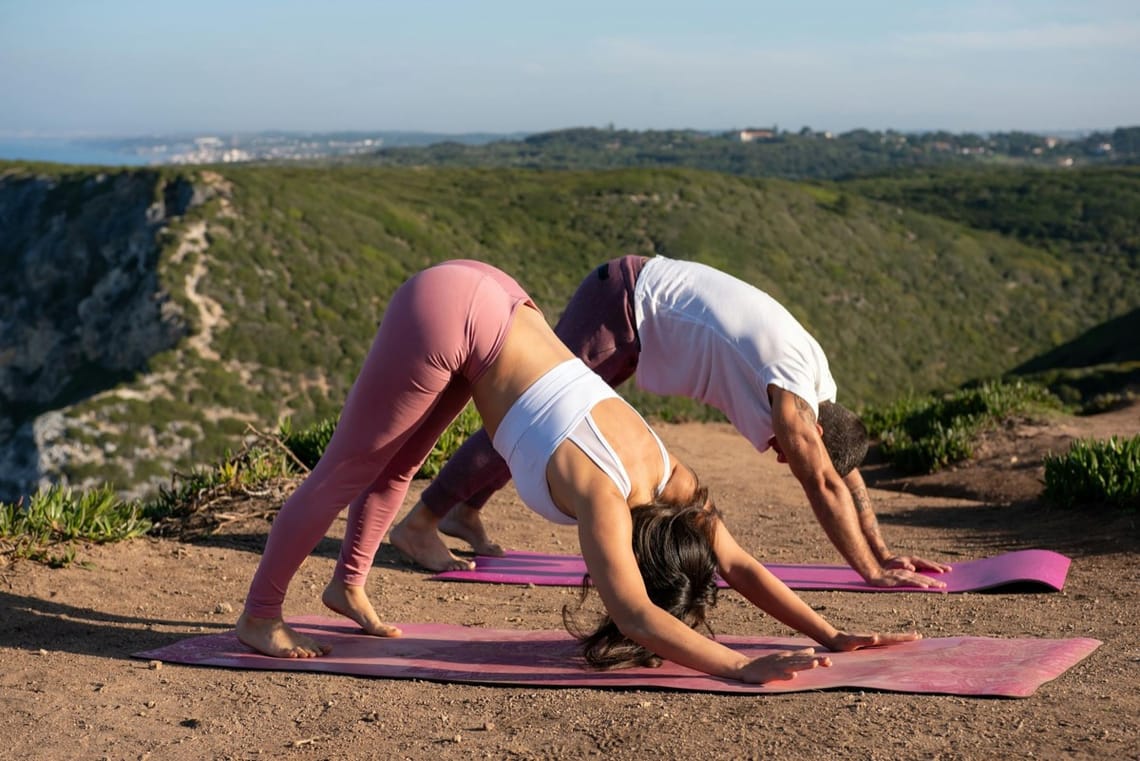
6. Downward Facing Dog — for hamstrings and calves
Cyclists often skip this pose because they feel "nothing" in a stiff body. After a few weeks of regular practice, it becomes one of the most useful poses in your kit.
How: Hands and feet on the mat, hips lifted into an inverted V. Bend the knees as much as needed to keep a long spine. Slowly pedal the heels down, alternating legs. Hold 8–10 breaths.
Why it works: Downward dog stretches the entire posterior chain — hamstrings, calves, Achilles — in a weight-bearing position that cycling never provides. The pedaling action mimics the movement your legs have been doing for hours, but through the full range.
7. Bridge Pose — for glute activation
Most cyclists are quad-dominant. Bridge pose activates the posterior chain — glutes and hamstrings — which cycling underuses despite working it constantly.
How: Lie on your back, feet flat on the floor hip-width apart. Press into your feet and lift your hips. Squeeze the glutes at the top. Hold 5 breaths, lower, repeat 3–5 times. For more challenge, hold for 30–60 seconds.
Why it works: Glute weakness is a primary cause of IT band syndrome, anterior knee pain, and lower back fatigue in cyclists. Bridge pose activates the glutes in hip extension — the exact movement pattern that cycling underutilizes. It's strength, not just stretching.
8. Chest Opener at the Wall — for shoulders and pec minor
Hours on the bars round the shoulders forward and shorten the pec minor. Left unaddressed, this becomes thoracic outlet syndrome, shoulder impingement, or chronic neck tightness.
How: Stand facing a wall. Place one forearm vertically against the wall, elbow at shoulder height. Gently rotate your body away from the wall until you feel a stretch across your chest and front shoulder. Hold 6–8 breaths per side.
Why it works: The pec minor and anterior deltoid are chronically shortened in cyclists. This stretch directly counteracts the forward shoulder position that the bars reinforce. Do this daily, not just on yoga days.
When to Do Yoga in Your Training Week
Timing matters. Yoga serves different purposes depending on where it sits in your training block.
Before a ride (10–15 min): Keep it dynamic. Sun salutations, leg swings, hip circles. You're activating, not stretching. Long holds before high-intensity efforts reduce power output temporarily.
After a ride (15–20 min): This is where the recovery work happens. Low lunge, pigeon, reclined figure four, supine twist. Hold each pose 1–2 minutes. Your muscles are warm and receptive.
Rest days (30–60 min): Deeper work. Yin-style holds, thoracic rotation, full hip sequences. This is when you build lasting mobility improvements rather than just releasing the day's tightness.
In-season vs. off-season: During heavy training blocks, keep yoga sessions short and recovery-focused. Use the off-season to build a consistent practice that addresses structural imbalances before they become injuries.
What a Structured Yoga for Cyclists Program Looks Like
Knowing individual poses is useful. Having a structured program is transformative.
A well-designed yoga for cyclists program works systematically through the imbalances cycling creates — not just hip flexors on day one and calling it done, but building flexibility and strength progressively, with attention to how each movement pattern affects your riding position.
LEARN WITH BE WELL ACADEMY
Yoga for Cyclists Course
Bethany Orbison built this course specifically around what cycling does to your body — targeting hip flexors, thoracic spine, hamstrings, and the shoulder tension that builds over long rides. 15 modules, breathwork included. Self-paced, so it works around your training schedule.
Explore the Course → $119 · One-time · Lifetime accessHow Often Should Cyclists Do Yoga?
Two to three times a week produces noticeable results within 4–6 weeks. Daily practice accelerates the timeline significantly — but even 15 minutes of targeted work after each ride will change how your body feels and recovers.
The biggest mistake cyclists make is treating yoga as something to add after an already full training schedule. The better frame: yoga replaces some of your recovery time. Instead of passive rest, you're actively restoring range of motion that makes your next ride better.
Yoga for Cycling Performance vs. Injury Prevention
Most cyclists start yoga to fix pain. They stay because it improves their riding.
Here's what consistent yoga practice does to your performance on the bike:
- More power from hip extension — when your hip flexors are mobile, your glutes can fully extend at the bottom of the pedal stroke. Tight hip flexors literally limit your power output by restricting the movement range your glutes need to fire fully.
- Better breathing — thoracic mobility directly affects respiratory capacity. A mobile thoracic spine lets your ribcage expand properly. Stiff cyclists breathe from the top of their chest. Mobile cyclists breathe from the diaphragm.
- More comfort in the aero position — hip flexor and hamstring flexibility lets you maintain a more aggressive position without discomfort. Triathletes and time trialists see the most direct benefit here.
- Faster recovery between efforts — the breathwork and parasympathetic activation from yoga practice helps your nervous system recover between hard intervals. This is measurable in HRV data.
Frequently Asked Questions
Can I do yoga on the same day as a hard ride?
Yes, but keep it gentle and recovery-focused post-ride. Avoid intense vinyasa or power yoga on hard training days — save those for rest days or easy days when your body can absorb the work.
Is yoga better before or after cycling?
Dynamic yoga (movement-based, shorter holds) works well before a ride for activation. Static yoga (longer holds, yin-style) is better after a ride or on rest days when muscles are warm and recovery is the goal.
How long before I see results from yoga as a cyclist?
Most cyclists notice improved hip mobility and reduced lower back tightness within 2–4 weeks of consistent practice. Significant structural changes — like lasting hip flexor length or thoracic rotation — typically take 2–3 months.
Do I need to be flexible to start yoga for cycling?
No. Stiffness is the reason to start, not a reason to wait. Most yoga poses can be modified with blocks, blankets, or by bending the knees. Starting stiff is normal and expected.
What style of yoga is best for cyclists?
Yin yoga and restorative yoga for deep tissue release and recovery. Vinyasa or hatha for strength and active mobility. A good yoga for cyclists program combines both — active work to build stability and passive work to release what riding compresses.
Go Deeper
Compare real programs in the OYP YTT Database:
Medical disclaimer: This content is for informational purposes only and is not a substitute for professional medical advice, diagnosis, or treatment. Always consult a qualified healthcare provider before beginning any new exercise program, especially if you have injuries, chronic conditions, or are pregnant. Listen to your body and stop any practice that causes pain.
Related programs in our directory:
Subscribe to the newsletter
Subscribe to my newsletter to get the latest updates and news