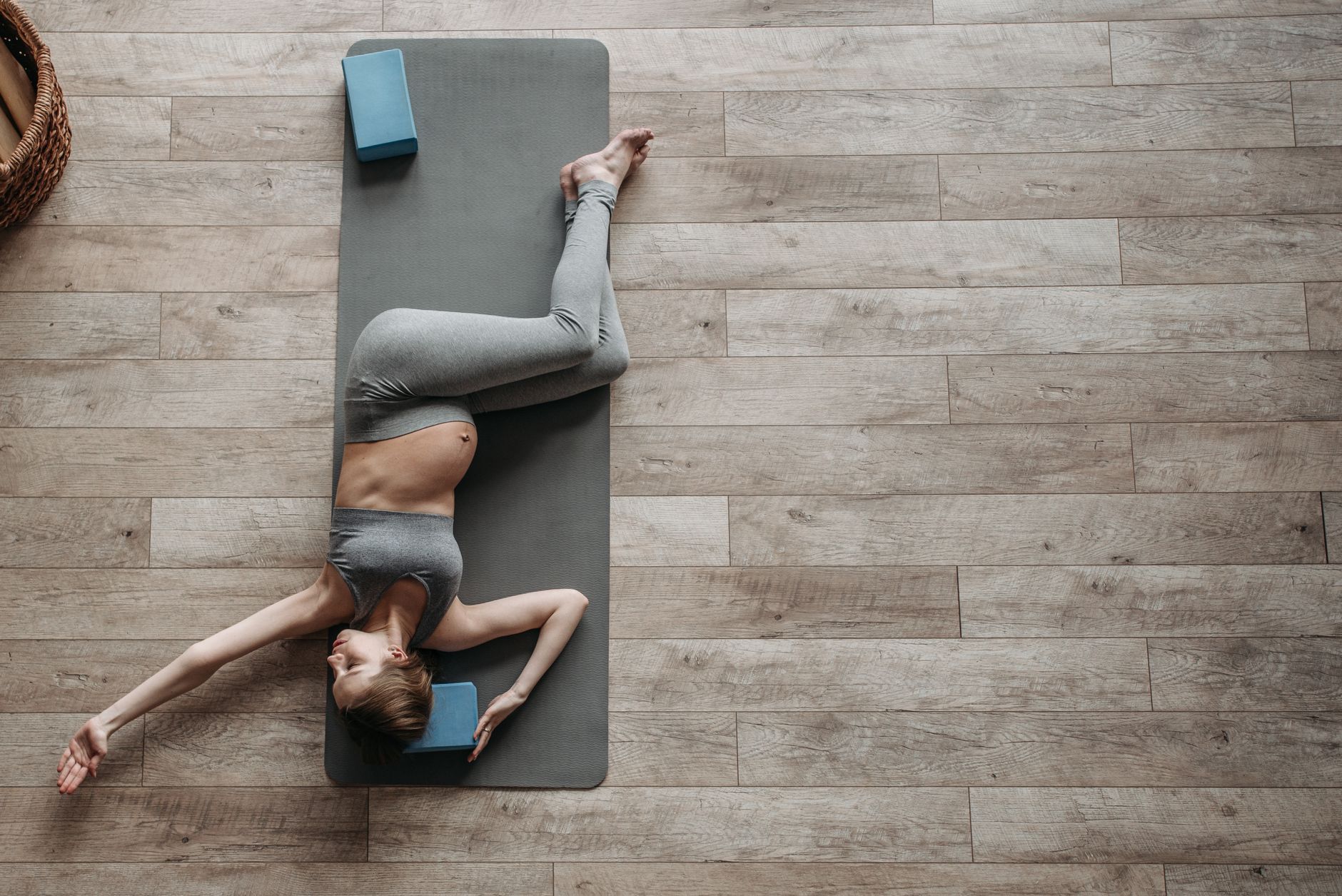
How to Build a Home Yoga Practice That Actually Sticks

You've set up the mat. You've saved the YouTube videos. You've told yourself this is the week you start practicing at home, and you mean it. Two weeks later the mat is rolled up in the corner and the videos are in a folder you haven't opened. This isn't a willpower problem. It's a design problem.
Home yoga practices fail not because people aren't committed, but because the practice hasn't been built in a way that accounts for how motivation actually works and how habits actually form. This post is about the structures that make the difference.
Why home practice is harder than going to class
In a studio class, someone else decides what you practice, when it starts, and when it ends. The social commitment (you paid, you showed up) reduces the decision burden. The music, the room, the teacher — they provide the external scaffolding that gets you through.
At home, you have to make all those decisions. And every decision costs energy. By the time you've decided what to practice, for how long, from what video, in which room — you've used the motivation you had. The practice hasn't even started and it's already work.
The solution is to reduce decisions to zero through advance design.
The three structures that make home practice stick
Structure 1: A permanent spot. Not "somewhere in the living room," not "I'll clear a space when I need it." A specific spot where the mat lives, unrolled, ready. When you have to unroll the mat, you've added a barrier. When it's already there, the barrier is removed. If you live in a small space, this might mean the mat stays rolled against one wall and opens to the same three feet of floor every time. The spot is sacred — not because of spirituality, but because of habit formation. Your nervous system learns that the spot means practice.
Structure 2: A fixed time. Not "whenever I have time" — that time will never materialize. A specific window, attached to something that already happens: before your morning coffee, immediately after lunch, before the evening shower. Habit researchers call this a "habit stack" — attaching a new behavior to an established one. "After I make my coffee, I do ten minutes of yoga" is dramatically more durable than "I'll do yoga when I feel like it."
Structure 3: A predetermined practice. Decide in advance, once per week, what you're practicing each day. Monday: hip openers. Tuesday: standing sequence. Wednesday: restorative. The decision has been made and it doesn't need to be remade on Monday morning when you're half-asleep. If you use video classes, queue them the night before. If you practice independently, write out your sequence on Sunday. The practice is waiting for you, not the other way around.
Starting shorter than feels right
The most common reason home practices fail is overambition. You commit to 45 minutes and when that feels too long on a Tuesday you skip entirely rather than do less. Start with ten minutes. Not as a temporary measure — as a deliberate choice. Ten minutes daily builds more neural architecture than 45 minutes twice a week. When ten minutes feels easy and natural (usually around week three), extend to fifteen. Let the habit establish itself before you add load.
Managing the unmotivated days
They'll come. Days when you don't want to do anything. The practice for those days is: get on the mat, lie down, and do three minutes of breathing. That's it. That counts. The goal is continuity of the habit, not quality of every single session. Three minutes of child's pose on a hard day is more valuable than the day you skip because you couldn't face a full practice.
When to supplement with classes
Home practice and studio practice aren't competing. A good home practice makes studio classes better — you arrive with body awareness and baseline conditioning that allows you to receive more from instruction. A studio class every week or two provides the external input and community that home practice can't fully replicate. Use both.
Frequently asked questions
Do I need a teacher to practice at home?
Not to start. A basic familiarity with common poses and sequences is enough to begin a sustainable home practice. If you're brand new to yoga, a few introductory classes or workshops will give you the embodied knowledge that videos alone don't fully provide.
What equipment do I need?
A mat, a block (or firm book), and a blanket. That's a complete home yoga prop setup. Straps are useful for flexibility work but not essential to start. Don't delay beginning practice until you have everything — start with what you have.
Where can I find well-structured sequences for home practice?
The OYP blog has sequences organized by duration, level, and focus area. If you want deeper guidance or personalized practice design, working with a teacher one-on-one — even a few sessions — is worth the investment. Browse our teacher training directory to find qualified teachers in your area or online.
Subscribe to the newsletter
Subscribe to my newsletter to get the latest updates and news