The 5 Best Yoga Adjustments Workshops Online for Teachers

Master yoga adjustments through specialized online training. These 5 programs teach anatomy, alignment, consent, and hands-on techniques for working safely with students.
You're standing at the back of your yoga class and notice a student pushing too hard in forward fold. Your instinct is to help, but you hesitate. Should you touch? Where? How much pressure? If you're asking these questions, you're not alone. Most yoga teachers learn adjustments through osmosis—watching other teachers, getting adjusted themselves—but rarely through formal training. The gap between intention and skill can leave both you and your students uncertain. That's where a dedicated yoga adjustments workshop changes everything.
Why Teachers Need Specialized Adjustments Training
The difference between a helpful adjustment and a harmful one often comes down to knowledge you don't yet have. Anatomy matters. Breath awareness matters. The student's energy and permission matter. Many teachers default to either avoiding adjustments altogether or applying techniques they half-remember from their own trainings. An online adjustments workshop fills that gap with structure, safety protocols, and repeated practice. You'll learn not just the how, but the why—and more importantly, when not to adjust at all. That discernment is what separates a teacher who occasionally helps from one students trust implicitly.
Yoga Alliance Certification and What It Means
Before diving into specific programs, understand the landscape. The Yoga Alliance, the largest nonprofit membership organization for yoga teachers in the US, recognizes two certification levels: RYT 200 (Registered Yoga Teacher with 200 hours) and RYT 500 (500 hours). Continuing Education (CE) credits earned through workshops count toward the 500-hour requirement. Most online adjustments workshops offer between 6 and 50 CE hours. A program accredited by Yoga Alliance carries weight when building your resume and credibility. That said, not all valuable training carries formal accreditation—sometimes the best teachers operate outside institutional frameworks. Look for programs that, at minimum, are taught by experienced instructors with transparent credentials.
1. Yoga Medicine: Structural Yoga Therapy Online Program
Best for: Anatomy-focused teachers and therapeutic adjustments
Yoga Medicine, founded by Dr. Lara Heimann (a physical therapist and experienced yoga teacher), offers an online Structural Yoga Therapy certification program. The full program runs 300+ hours and costs around $3,500-$4,200 depending on payment plan. If a full program feels like too much, Yoga Medicine also sells standalone anatomy and adjustments modules for $400-$800 each. What sets Yoga Medicine apart is the integration of physical therapy principles with traditional yoga teaching. You'll learn not just how to adjust, but how to assess students for limitations, contraindications, and individual anatomy variations. The modules use video demonstrations, anatomy illustrations, and case studies. The program is recognized by Yoga Alliance for CE credit.
What to expect: Detailed anatomy breakdowns of hip structure, spine variations, and shoulder mechanics. You'll study common misalignments in poses like Warrior II and Pigeon, then learn precise adjustment techniques. The instruction assumes no prior anatomy background. One limitation: the video format can feel clinical rather than immersive, so if you're a kinesthetic learner who needs hands-on practice, pair this with live virtual sessions or in-person intensives.
2. Down Under Yoga: Online Hands-On Adjustment Workshops
Best for: Immediate skill building in a small group
Down Under Yoga, based in Australia, runs live online adjustment workshops ranging from single 2-hour sessions ($40-$60) to multi-week courses ($300-$600). These are genuinely interactive: you practice on a partner at home while instructors guide you via Zoom, and you get real-time feedback on your hand placement, pressure, and timing. Sessions typically cap at 15 teachers, creating accountability and community. The programs focus on practical adjustment sequences for standing poses, forward folds, and backbends. Each session includes safety protocols aligned with the Yamas and Niyamas—particularly the principle of Ahimsa (non-harm).
What to expect: You'll need a partner to practice with (another teacher, a spouse, a friend). The instructor talks you through modifications for different body types. Breathing, consent language, and verbal cues are woven throughout. If you live outside Australia, time zones can be challenging, but Down Under Yoga records sessions and offers them on-demand. This is the most peer-oriented option—you're not just watching; you're practicing in real time.
3. The Adjustment Lab: Online Certification Track
Best for: Teachers wanting a structured multi-module path
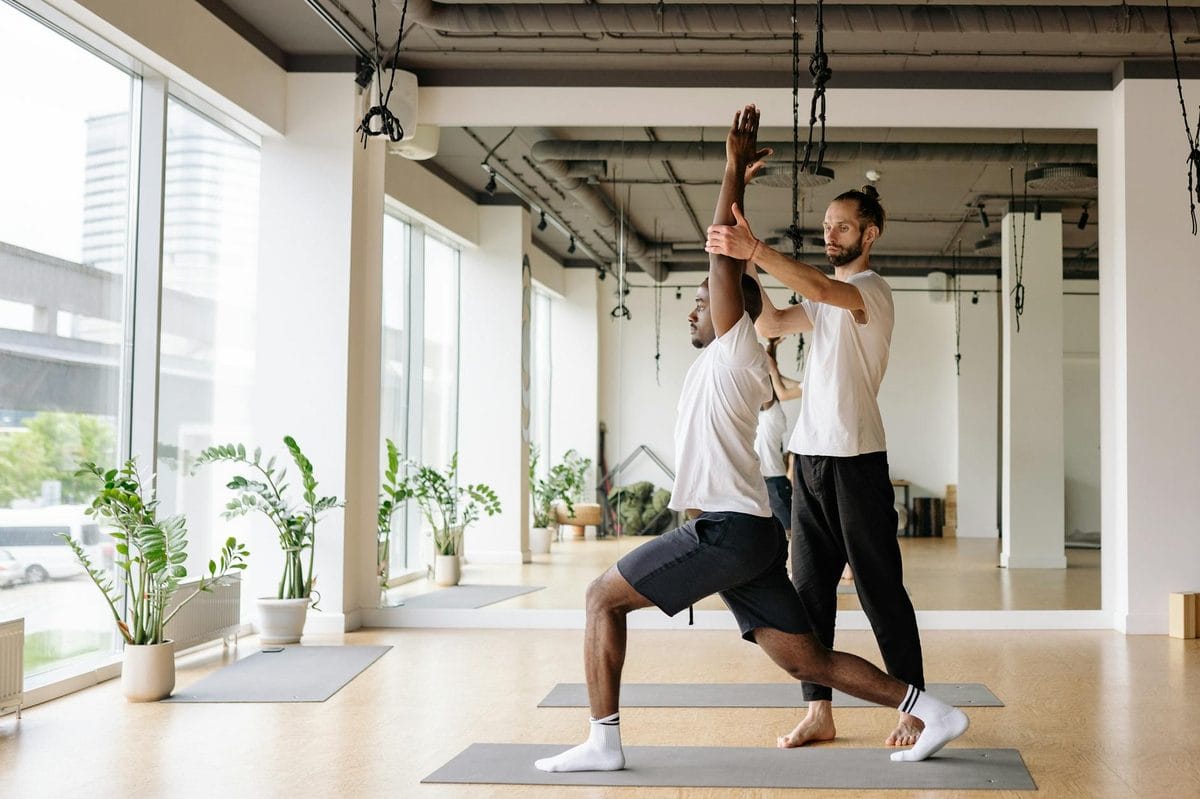
The Adjustment Lab offers a tiered online certification in yoga adjustments: Foundation (50 hours, ~$895), Intermediate (50 hours, ~$895), and Advanced (50 hours, ~$895). You can take them sequentially or enroll in the full 150-hour program (around $2,400). The program is taught by experienced hands-on teachers and uses a mix of pre-recorded video instruction and monthly live group calls. Each module covers specific asana families: hip openers, backbends, twists, and inversions. You'll learn not just the adjustment itself, but how to read the student's body and modify your technique based on their structure and breath.
What to expect: Detailed video demonstrations from multiple angles, written study guides, and anatomy illustrations. The monthly live calls are where you ask questions specific to your teaching context. Unlike some purely self-paced programs, this feels like membership in a teacher community. Yoga Alliance CE credit is available. One thing to note: this program assumes you already teach yoga and have some anatomical baseline knowledge.
4. Jivamukti School: Living Yoga Teacher Training with Adjustment Focus
Best for: Teachers seeking philosophy alongside hands-on technique
Jivamukti, a major yoga school founded in New York in 1984, offers online teacher trainings that weave adjustment technique into the broader philosophy of yoga. Their 200-hour online program costs around $3,000-$3,500 and includes modules on adjustments taught alongside study of the Yoga Sutras and ethical teachings. While not exclusively an adjustments workshop, the Jivamukti approach ensures you're learning adjustments as an expression of Satya (truthfulness) and Ahimsa rather than as isolated techniques. Live online sessions with senior teachers provide feedback on your understanding and practice.
What to expect: If you want adjustments training grounded in philosophy and ethics, not just biomechanics, Jivamukti is worth considering. The drawback is that adjustments are one component of a larger 200-hour program, so you're not getting the specialization of a dedicated adjustments workshop. The program includes reading assignments from yogic texts and requires genuine engagement with philosophy, not just technique.
5. Alo Moves: Adjustments and Assists Video Library
Best for: Budget-conscious teachers who want on-demand access
Alo Moves is a subscription-based platform ($13-$20 per month or $99-$150 per year) with hundreds of yoga classes and dozens of adjustment tutorials taught by experienced instructors. While not a formal certification program, the adjustments content is well-produced and organized by pose. You can learn adjustment techniques for Downward Dog, Warrior I, Wheel, and more at your own pace. The subscription includes everything on the platform—classes, meditations, adjustment tutorials—so if you're already using Alo Moves, the adjustments content is included. No CE credit, no official credential, but genuine value for teachers on a tighter budget.
What to expect: Video demonstrations with clear angles and verbal cueing. No interaction with instructors, no certification, no community, but exceptional convenience and affordability. Best used as supplementary learning or a refresher tool rather than your primary adjustments training.
How to Choose the Right Adjustments Workshop for You
Consider your teaching context
Are you teaching in a studio, corporate setting, or private sessions? Teaching older adults or athletes? Your specific student population shapes what adjustments knowledge matters most. A studio teacher working with general population benefits from broad foundation training. A teacher working exclusively with senior students needs specialized knowledge of contraindications and gentle alternatives.
Budget and time investment
A multi-week or multi-month program (Yoga Medicine, The Adjustment Lab, Jivamukti) costs $2,500-$4,000 and requires 5-10 hours per week. A focused short workshop (Down Under Yoga single sessions) costs $40-$60 and takes 2 hours. Alo Moves is the lowest barrier to entry. There's no wrong choice—it depends on your season of life and how much capacity you have.
Learning style preferences
Do you learn best from live interaction, recorded video, reading, or hands-on practice? Yoga Medicine excels at detailed written material and anatomy. Down Under Yoga thrives on live feedback. The Adjustment Lab balances video and live calls. Alo Moves is pure video on demand. Honest assessment of how you actually learn—not how you think you should learn—saves frustration.
Accreditation and credentials
If you're building toward RYT 500 or tracking CE credits, prioritize Yoga Alliance-accredited programs. If credentials matter less than practical competence, a well-taught workshop from a respected instructor outside the formal system can serve you just as well.
Key Principles Across All Quality Adjustments Training
Whatever program you choose, the best adjustments training emphasizes these non-negotiables: first, consent—always ask before touching and check in during the adjustment. Second, anatomy—understanding bone structure and individual variation prevents injury. Third, breath awareness—you're supporting the student's inhale and exhale, not imposing your will. Fourth, minimal force—good adjustments use leverage and alignment, not strength. Finally, recognition of contraindications—knowing when not to adjust is as important as knowing how.
Start with one program that matches your learning style and circumstances. You don't need every workshop. One solid foundational training, followed by occasional refresher content, builds competence and confidence. Your students will feel the difference immediately—not because you're physically powerful, but because your touch carries knowledge, respect, and genuine care for their practice.
Go Deeper
Compare real programs in the OYP YTT Database:
Related programs in our directory:
Subscribe to the newsletter
Subscribe to my newsletter to get the latest updates and news